

Arabic Teacher Online for Kids: The Complete Parent’s Guide
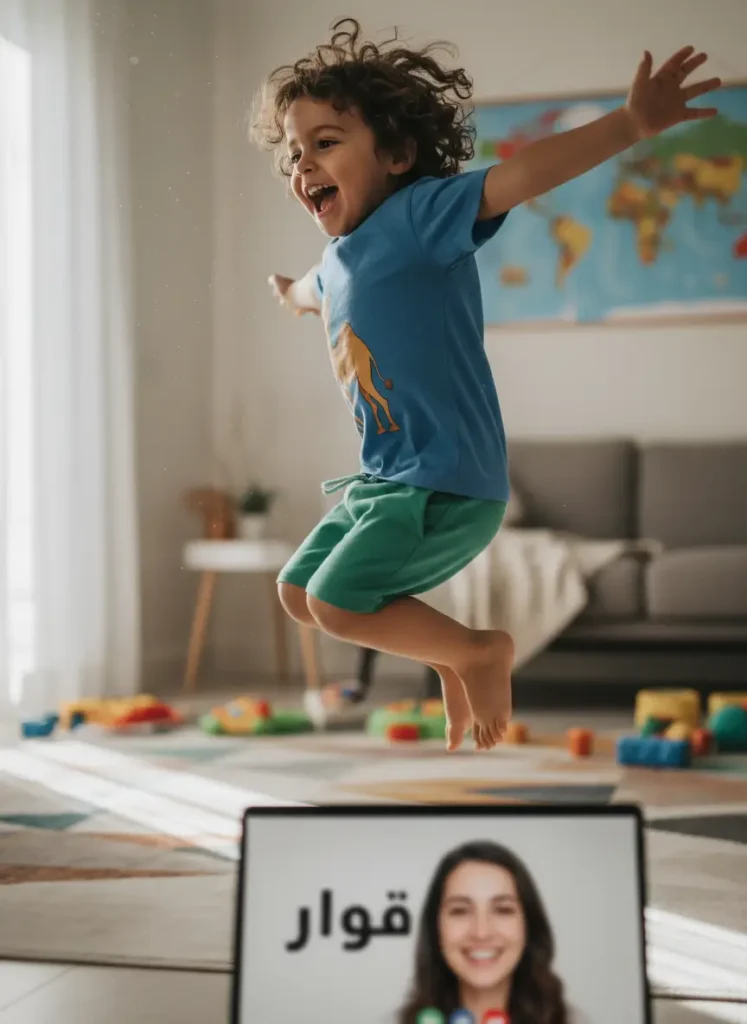
Image suggestion: Smiling Egyptian female teacher on video call with engaged young child at laptop Alt text: Arabic teacher online for kids one-on-one live lesson at home
Finding a qualified Arabic teacher online for your child is the single most important decision you’ll make in their Arabic education. The right teacher doesn’t just teach vocabulary — they build confidence, correct pronunciation before bad habits form, and make children genuinely want to show up every week.
This guide covers everything: what makes a teacher truly qualified, how to spot red flags, when your child needs intensive tutor support versus standard lessons, and exactly how to find the right match. No fluff. Just what you need to make the right call.
Why an Arabic Teacher Is Non-Negotiable — Not Optional
Here’s the honest truth that most language apps won’t tell you: your child cannot reach meaningful Arabic proficiency through apps and videos alone. Not even close.
And I’ll be straight with you — this isn’t a sales pitch. It’s what the research consistently shows, and what thousands of parents discover after months of trying digital-only approaches.
What Apps and Videos Simply Cannot Do
They can’t hear your child’s mistakes. Arabic has sounds that don’t exist in English: ع (‘ayn), ح (ha), خ (kha), غ (ghayn), ق (qaaf). Your child might genuinely believe they’re pronouncing ع correctly while actually producing أ (alif) every time. An app cannot hear this difference. A qualified teacher hears it immediately — and corrects it before it becomes permanent.
They can’t answer your child’s questions. Your 7-year-old asks, “Why does this word end differently here?” A video keeps playing. A teacher stops, explains the concept at exactly the right level, gives three examples, and checks understanding. That’s a completely different experience.
They can’t adapt to your child’s specific pace. Some children grasp vocabulary quickly but struggle with pronunciation. Others memorise patterns easily but need more time with the script. Apps follow predetermined paths. Teachers adjust in real time, in every single session.
They can’t provide human encouragement. When your shy 6-year-old finally pronounces a difficult word correctly, she needs to see a teacher’s proud smile. She needs to hear genuine praise from a person who knows her. That emotional validation builds the confidence and motivation that makes children come back willingly — session after session.
This is what technology cannot replicate. And it’s not a small thing.
The Research Is Clear
Teacher quality is the single most important in-school factor affecting student outcomes. For language learning specifically, effective teachers accelerate acquisition by 2 to 3 times compared to ineffective ones. Live feedback from qualified teachers prevents the “fossilisation” of errors — mistakes that become permanent without correction.
Apps and videos have their place as supplements. But they cannot replace qualified human instruction. Full stop.
Who Is This Guide For?

This guide is for you if…
- Your child is between ages 3 and 16 and you want to find a qualified Arabic teacher online
- You’ve tried apps or group classes and aren’t seeing real progress
- Your child needs extra support — perhaps they’re behind peers, resistant to standard lessons, or need accelerated progress for Quran
- You’re a heritage family wanting to reconnect your child with Arabic
- You want to know exactly what credentials to look for and what questions to ask
This is NOT the guide for you if…
- You’re looking for free resources to supplement existing instruction — check our Kids Arabic Lessons & Activities guide for that
- Your child is already advanced and just needs conversation practice — see all available programs for intermediate and advanced options
Common Mistakes Parents Make When Choosing an Arabic Teacher
These mistakes are expensive — in time, money, and your child’s motivation. Know them upfront.
Mistake 1: Choosing based on price alone
The cheapest option is rarely the best value. A $12/session tutor who teaches your child incorrect pronunciation for 6 months costs far more than a $25/session qualified teacher who builds a solid foundation from week one. Unlearning errors takes 3 times longer than learning correctly. Invest in quality early.
Mistake 2: Not verifying credentials
“I’m a native Arabic speaker” is not a qualification for teaching children. Speaking a language and teaching it to young learners are completely different skill sets. Ask for formal teaching credentials, not just language fluency. More on what to ask in the next section.
Mistake 3: Skipping the trial session
Never commit to a teacher or program without your child meeting them first. Your child’s engagement in the first 15 minutes of a trial session is the most reliable predictor of long-term success. If they’re leaning forward, responding, laughing — that’s the teacher. If they’re glazed over — move on.
Mistake 4: Choosing a teacher without children’s experience
This is a big one. An excellent adult Arabic teacher may be completely ineffective with a 7-year-old. Teaching children requires specialist skills: patience, age-appropriate explanation, short activity cycles, positive reinforcement systems, and the ability to maintain engagement for an entire session. Always ask specifically about experience teaching children.
Mistake 5: Starting and stopping repeatedly
Three sessions with Teacher A, then a 6-week break, then 4 sessions with Teacher B — this pattern produces almost no progress. Consistency is the most important factor in children’s language acquisition. Once you find a good teacher, commit to regular sessions and hold them consistently.
What Makes an Arabic Teacher Truly Qualified for Children
Not everyone who speaks Arabic can teach it effectively to children. Here’s exactly what to look for.
Non-Negotiable 1: Native Arabic Speaker
For children’s Arabic instruction, native speakers are the strongly recommended standard. Why? Because children’s phonological development depends on accurate models. If a teacher pronounces ح (ha) like ه (haa), or ق (qaaf) like ك (kaaf), your child will learn those errors as correct — and unlearning them later is genuinely difficult.
Native Arabic speakers produce all Arabic sounds correctly without conscious effort. They have the intuitive grammar that comes only from growing up in the language. They carry authentic cultural context that non-native teachers, however skilled, can’t fully replicate.
Egyptian Arabic is the most widely understood dialect across the Arab world — which is why our teachers at Alphabet Arabic Academy are all certified native Egyptian speakers. For Quranic Arabic, Egyptian teachers with Al-Azhar University training are the gold standard.
Non-Negotiable 2: Formal Teaching Credentials
Look for one or more of the following:
- Degree in Arabic Language Education or Teaching Arabic as a Foreign Language
- Teaching certificate from a recognised institution (Al-Azhar, Cairo University, or equivalent)
- Specialist training in children’s language education
- ACTFL or equivalent international language teaching certification
A red flag: anyone who says “I’m a native speaker so I can teach” without any formal training. Speaking fluently is necessary but not sufficient.
Non-Negotiable 3: Specific Children’s Experience
Minimum 2 to 3 years teaching Arabic specifically to children. Not just adults — children. Ask directly: “How many years have you taught Arabic to kids? What age groups? What do you adjust between teaching a 5-year-old and a 12-year-old?”
Good teachers will have clear, specific answers. Vague responses are a red flag.
Non-Negotiable 4: Child-Friendly Teaching Personality
This is harder to assess on paper but essential. The best children’s Arabic teachers share a specific set of qualities: genuine patience (they don’t show frustration when a child makes the same mistake repeatedly), natural warmth and enthusiasm, a gift for positive reinforcement, and the flexibility to change approach when something isn’t working.
The trial session reveals all of this. Watch how the teacher responds when your child hesitates or makes an error. That tells you more than any CV.
Non-Negotiable 5: Proven Online Teaching Skills
Online teaching is a specific skill distinct from in-person instruction. Look for: stable technology setup, minimum 1 to 2 years’ experience teaching children specifically online, proficiency with interactive digital tools (whiteboards, flashcard systems, screen sharing), and engagement techniques that maintain a child’s attention through a screen.
When Your Child Needs an Arabic Tutor: Intensive One-on-One Support
There’s an important distinction between standard Arabic classes for kids and intensive tutoring. Standard group or one-on-one classes work well for most children making normal progress. But some children need a different level of support.
Signs Your Child May Need Intensive Tutoring
They’re falling behind peers. If your child is in an Arabic class but consistently struggling to keep up — not understanding lessons, unable to complete basic exercises that classmates find manageable — individual tutoring addresses the specific gaps rather than trying to keep pace with a group.
They’ve developed incorrect habits that need correction. Some children learn Arabic for years with certain errors — mispronunciations, grammar patterns, writing problems — that have become deeply embedded. Correcting fossilised errors requires intensive, targeted, one-on-one attention over an extended period.
They need accelerated progress for a specific deadline. Starting Quran lessons soon and need a foundation first. Moving to an Arab country within 6 months. Entering an Arabic-medium school in September. These situations require intensive focused instruction that standard weekly classes can’t provide.
They have a learning difference that requires adaptation. Children with dyslexia, ADHD, anxiety, or other learning differences often need a highly customised approach that a group or standard class can’t accommodate. The right intensive tutor adapts every aspect of instruction to your child’s specific needs.
They’re starting significantly later than peers. A 12-year-old who has no Arabic experience, entering a school where classmates have studied for 4 years, needs intensive acceleration — not standard beginner pace.
What Intensive Tutoring Looks Like
Intensive Arabic tutoring means 3 to 5 sessions per week (rather than the standard 1 to 2), each session deeply focused on a specific, targeted objective. The teacher conducts a thorough assessment first: identifying exactly where the gaps or errors are, what your child already knows well, and what the most efficient path to your goal looks like.
Progress is tracked weekly with clear, measurable milestones. Parents receive regular updates — not just “she’s doing well” but specific feedback: “She can now read the following letter combinations accurately. Next week we’re focusing on these sounds.”
At Alphabet Arabic Academy, our intensive programs for children start at $100/month for 12 sessions (3 per week) and $135/month for 20 sessions (5 per week). Every session is one-on-one with a certified native Egyptian teacher specialising in children. View full details and pricing here.
How to Teach Arabic to Kids Effectively: What the Best Teachers Do
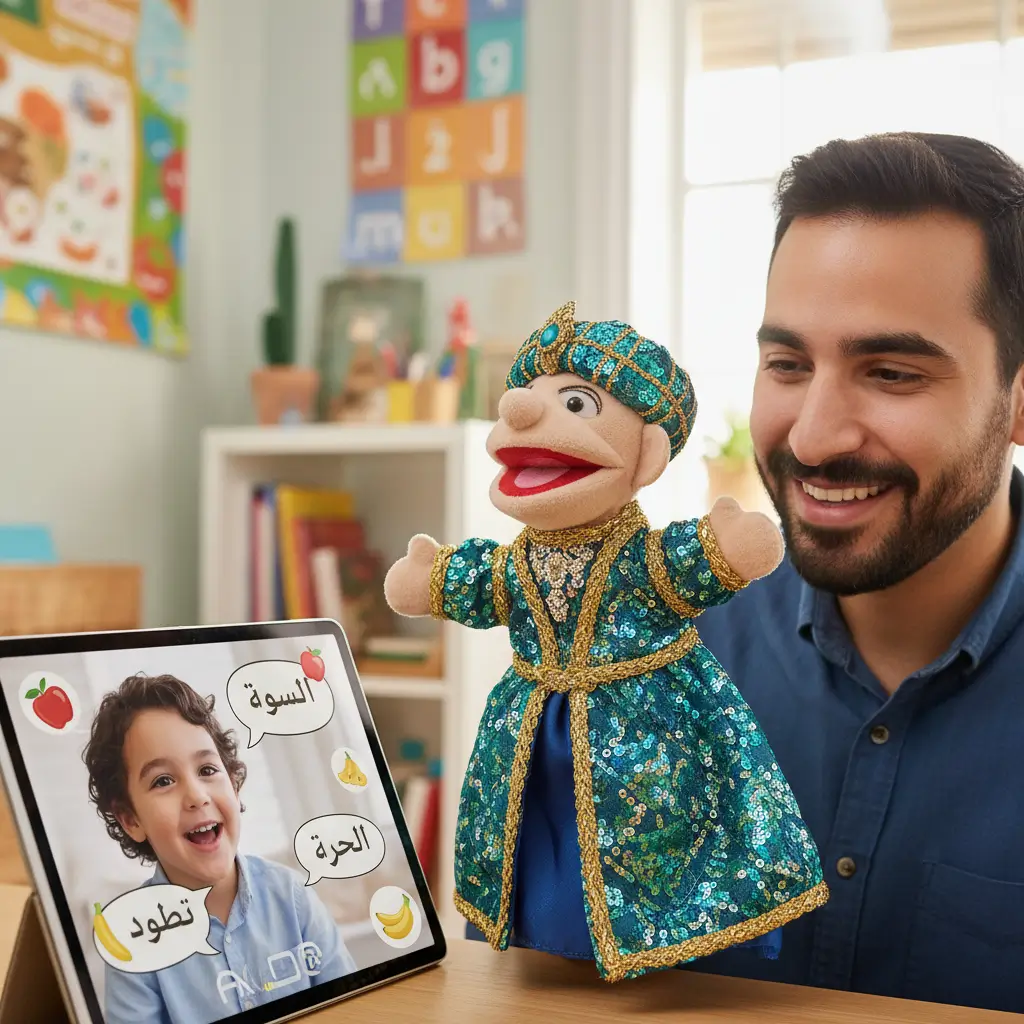
You might be wondering: what does an excellent online Arabic lesson for a child actually look like? Here’s what distinguishes truly effective children’s Arabic teaching from the average.
Games and Play as Primary Vehicles, Not Additions
The best children’s Arabic teachers don’t add games to lessons as rewards or breaks. They build the entire lesson structure around play. This isn’t just about keeping children happy — it’s about how children actually learn.
When a child is engaged in a matching game, they’re retrieving Arabic vocabulary under mild competitive pressure. That retrieval practice — trying to remember a word and checking if you’re right — is one of the most effective learning mechanisms available. The game is the lesson.
Effective games include word bingo, Arabic memory match, picture-to-word treasure hunts, role-play scenarios (ordering food, greeting family, shopping), and alphabet puzzles. A teacher who uses these consistently produces better results than one who relies on drilling and repetition.
Interest-Based Content from Day One
A football-obsessed 10-year-old learns Arabic vocabulary about sport, numbers, competitions, and team names. A child who loves animals learns from Arabic stories, poems, and conversations about animals. The teacher’s skill lies in delivering the curriculum through content the child genuinely cares about.
This approach does two things: it maintains engagement (the child doesn’t notice they’re “studying”) and it creates personal, emotionally meaningful memory anchors for new vocabulary. Words connected to genuine interest are retained 3 to 4 times longer than words from neutral content.
Short Activity Cycles with Varied Input
Children — especially under age 8 — cannot maintain focused attention on a single type of activity for long. The best teachers move through activity cycles of 5 to 7 minutes: alphabet practice, then a quick game, then listening to a short story, then vocabulary review, then free speaking. Each shift resets attention without losing learning momentum.
The total session might be 30 minutes, but it feels like 10 because it’s varied and engaging.
Immediate, Positive Pronunciation Correction
Pronunciation must be addressed from lesson one — not deferred until “later.” But how a teacher corrects matters as much as whether they correct.
Effective correction sounds like this: “That’s so close! Let me show you — this sound comes from right here [demonstrates]. Try again — great, you’ve got it!” Not: “No, that’s wrong. Again.” The first builds confidence and creates a memory anchor. The second creates anxiety around speaking, which is the single biggest blocker for children’s language progress.
Clear Parent Communication
A good teacher for children doesn’t just report to the child — they keep parents informed. Monthly or bi-weekly progress reports covering specific skills, current level, what to practise at home, and next lesson objectives. Parents who understand what’s being taught can reinforce it naturally in daily family life, which dramatically improves outcomes.
Interactive Arabic Classes for Kids: What to Expect Online
Many parents worry that online Arabic classes can’t be as engaging as in-person ones for children. In practice, the opposite is often true.
Online lessons for children, when designed well, offer advantages that physical classrooms can’t:
Digital interactive tools. Online whiteboards where children trace Arabic letters in real time. Screen-shared flashcard games. Digital storybooks the teacher and child read together. Interactive pronunciation exercises with instant audio feedback. These tools aren’t available in most physical classroom settings.
The home comfort advantage. Shy children often perform significantly better from the safety of home than in a physical classroom with peers watching. The one-on-one, screen-mediated format removes the social anxiety that blocks many children in group settings.
Parent observability. When a class is online at your kitchen table, you can hear exactly what’s being taught, observe your child’s engagement, and ask the teacher questions directly. That transparency is genuinely valuable.
Flexibility for real family life. A qualified online teacher can schedule sessions at 6:30 PM on Tuesday and 4 PM on Saturday, across any timezone. That flexibility makes consistent practice sustainable for busy families.
What an Interactive Online Arabic Session for Kids Looks Like
Opening (3 to 5 minutes): Teacher greets child in Arabic, brief warm-up conversation about the week, child answers in Arabic using known vocabulary. Immediate positive reinforcement.
Review (5 minutes): Quick review of last session’s key words or structures using digital flashcards or a brief game.
New content introduction (7 to 10 minutes): New vocabulary, letter patterns, or grammatical structure introduced through a story, visual, or game — never through abstract explanation alone.
Practice activity (7 to 10 minutes): Child practises new content through an interactive exercise — pronunciation game, writing on shared whiteboard, role-play dialogue.
Closing (3 to 5 minutes): Review of session’s key learning, brief preview of next lesson, short home practice suggestion (5 minutes maximum).
Total: 30 minutes for younger children (ages 3 to 7), 45 to 60 minutes for older children (ages 8+).
Let me tell you about Yusuf.
He was seven years old. Shy. Reserved. When his mother first put him in front of the camera for an Arabic trial lesson, he barely looked at the screen. He answered in whispers. His mother was worried — “Maybe he’s not ready for online learning.”
But his teacher, Ustadha Fatima, didn’t push. She just started playing a game. A simple matching game — picture to Arabic word. Yusuf leaned forward slightly. She asked him a question — not about the lesson, about his favorite animal.
“Cat,” he whispered.
“Well done! Excellent!” she said, smiling warmly. “I love cats too. What color is your cat?”
White, he said. Still quiet — but engaged.
By the end of the trial, Yusuf was smiling. His mother booked the program the same day.
Six months later? Yusuf speaks in full Arabic sentences with his teacher. He reads short stories. He volunteers answers without being asked. His classroom teacher recently told his mother: “Yusuf is one of the most confident Arabic speakers in his class.”
That’s what the right teacher can do — not just teach Arabic, but unlock a child’s confidence.
The right match changes everything.
How to Find the Right Teacher: A Step-by-Step Process
Step 1: Define Your Child’s Specific Needs
Before you search for a teacher, answer these questions:
- Age and current Arabic level?
- Goal: Quranic reading, conversational Arabic, heritage maintenance, school preparation?
- Learning style: Does your child engage more with stories, games, movement, visuals?
- Personality: Shy and needs gentle encouragement? Competitive and responds to games? Energetic and needs movement built in?
- Schedule: What days and times work consistently for your family?
These answers let you match teacher to child rather than just finding any available teacher.
Step 2: Verify Credentials — Non-Negotiably
Before scheduling any trial, verify:
- Native Arabic speaker (Egyptian, Syrian, Lebanese, etc.)
- Formal teaching qualification (degree or certificate from recognised institution)
- Specific experience teaching children of your child’s age group
- Verifiable references from other parents
At Alphabet Arabic Academy, all these qualifications are verified before any teacher joins our team. Less than 15% of applicants pass our full screening process. Meet our teachers here to see full credentials and backgrounds.
Step 3: Schedule a Trial Session — And Observe Closely
Don’t just watch the lesson. Watch your child. Specifically:
- Are they leaning towards the screen or leaning back?
- Are they smiling, laughing, or responding spontaneously?
- Do they look anxious or relaxed?
- At the end of the session, do they want more — or do they seem relieved it’s over?
Children’s bodies don’t lie. Their engagement level during the trial session predicts long-term success far better than any assessment.
Step 4: Assess the Teaching Approach
During the trial, note: Does the teacher use games and activities, or mostly drilling? Does she correct pronunciation — and how? Does she adjust her approach when something isn’t working? Does she make your child feel capable and confident? Does she communicate naturally with you, the parent, about what the session covered?
Step 5: Commit to Consistency
Once you’ve found the right match — commit to a regular schedule and hold it. Minimum twice weekly for meaningful progress; three times weekly is optimal. Children’s language acquisition depends heavily on regularity. A good teacher, seen consistently, produces results that would take triple the time with irregular sessions.
Beginner Arabic Lessons for Children: Starting from Zero
Many parents worry about starting their child in Arabic when they’ve never seen the language before. Here’s the honest picture: starting from zero is perfectly fine. Expected, even.
Children at ages 3 to 5 are in the optimal window for phonological acquisition. They can learn to produce all Arabic sounds, including the ones that adults find difficult, with far less effort than older learners. The critical period for native-like pronunciation is before age 7. Starting early is genuinely advantageous.
For complete beginners, effective first lessons look like this:
The alphabet, introduced through sound and play. Not “memorise these 28 letters.” Instead, 3 to 4 letters per session, introduced through songs, traced on a shared whiteboard, connected to objects the child already knows (أ = أسد, asad — lion). Within 4 to 6 weeks of 2-weekly sessions, most children can identify and produce all 28 letters.
High-frequency spoken vocabulary in context. Greetings, numbers, colours, family members, food, common objects. Not random word lists — vocabulary that children can immediately use in sentences. By week 4, most beginners can introduce themselves, count to 10, and name 20 common objects in Arabic.
Reading readiness built gradually. Letter recognition → letter sounds → short words → short sentences. The Arabic writing system, once the letters are learned, is remarkably phonetic — words are generally pronounced exactly as written. This makes reading progress faster than in English once the foundation is solid.
What children should not experience in early lessons: drilling, pressure, anxiety about making mistakes, or long passive explanations. All of those slow acquisition and create negative associations with Arabic.
Not sure what level your child is at? Even for children starting from zero, taking our free placement assessment helps us match them with exactly the right starting point and teacher.
Our Kids’ Programs at Alphabet Arabic Academy
At Alphabet Arabic Academy, we’ve designed three levels of children’s Arabic programs to match different goals and family schedules.
Light Program — $35/month 4 sessions per month (1 per week). Ideal for families beginning Arabic, heritage children maintaining existing skills, or children alongside intensive home practice. 30-minute sessions with a certified native Egyptian teacher.
Standard Intensive — $100/month 12 sessions per month (3 per week). Our most popular children’s program. Designed for children making consistent progress toward conversational Arabic, Quranic reading foundations, or school preparation. 45-minute sessions.
Super Intensive — $135/month 20 sessions per month (5 per week). For children needing accelerated progress — significant gaps to close, specific deadlines, or intensive Quran preparation. Full 45-minute sessions five times weekly.
All programs include: certified native Egyptian teacher specialising in children, all materials and PDFs at no extra cost, monthly progress reports to parents, flexible scheduling across all timezones, and a free trial session before any commitment.
View full program details and pricing here.
For a full breakdown of our pricing across all age groups and programs, see our complete FAQ and pricing guide.
Frequently Asked Questions
Q1: How much should a quality online Arabic teacher for kids cost?
For qualified native-speaking teachers with children’s experience, expect $20 to $35 per 45 to 60 minute session. Monthly packages (8 to 20 sessions) typically offer better value. Be cautious of anything under $12 to 15 per session — that price point rarely corresponds to the qualifications your child needs.
Q2: Does dialect matter when choosing a teacher for my child?
Yes. Egyptian Arabic is the most widely understood dialect across the Arab world, making it the most practical choice for conversational Arabic. For Quranic Arabic, Egyptian teachers with Al-Azhar training are the gold standard. If you have family heritage ties to a specific country, that dialect might be preferable for maintaining family connection.
Q3: How many sessions per week does my child actually need?
Minimum twice weekly for meaningful progress. Three times weekly is optimal. More than four sessions weekly risks burnout for most children. Consistency matters more than total hours — two sessions every week beats six sessions one week and zero the next.
Q4: My child is shy and anxious about speaking. Will online lessons work?
Honestly, many shy children do better online than in physical classrooms. The home environment removes social anxiety about peers watching. One-on-one attention from an encouraging teacher — without an audience — creates the safest possible speaking environment. Most shy children open up significantly within 3 to 4 sessions with the right teacher.
Q5: What age is best to start online Arabic classes?
Children as young as 3 can start online Arabic with the right teacher and program. Ages 4 to 6 is often ideal — the combination of old enough to engage with screen-based activities and young enough to be in the optimal phonological acquisition window. But children benefit at any age. A 12-year-old with no Arabic experience will still make excellent progress with consistent quality instruction.
Q6: Can I combine Arabic language classes with Quran lessons?
Yes — and many families do. We offer integrated programs where Arabic language foundations support Quranic reading. Many parents start with basic Arabic classes and add Quranic study once foundational reading skills are in place. Discuss your goals with us and we’ll design the right combination.
Conclusion
Apps will plateau. Videos will bore. YouTube channels won’t remember your child’s name or notice when they’ve mastered a sound that was difficult last month.
The right Arabic teacher online for your child does all of that — and more. She builds pronunciation from the first session. She adjusts her approach the moment something isn’t working. She makes your 6-year-old feel capable and excited, session after session. She communicates with you so you can reinforce learning at home.
That human element is irreplaceable. It’s what produces the results that parents actually want: a child who speaks Arabic confidently, reads Arabic naturally, and identifies with the language as their own.
At Alphabet Arabic Academy, we’ve been making exactly those matches for years. 5,000+ students from 80 countries. A 4.9/5 rating on Trustpilot. Certified native Egyptian teachers — many Al-Azhar graduates — who specialise in young learners. Programs from $35 to $135 per month depending on intensity, with all materials included and flexible scheduling 7 days a week.
The first step is a free trial session — no commitment, no pressure. Your child meets a teacher, we see how they connect, and you make an informed decision from there.
Book your child’s free trial session here and find out what the right teacher can do.
“المعلم الجيد يصنع الفرق” — A good teacher makes all the difference.
That teacher is waiting. Give your child the gift of Arabic — the right way, from the start.